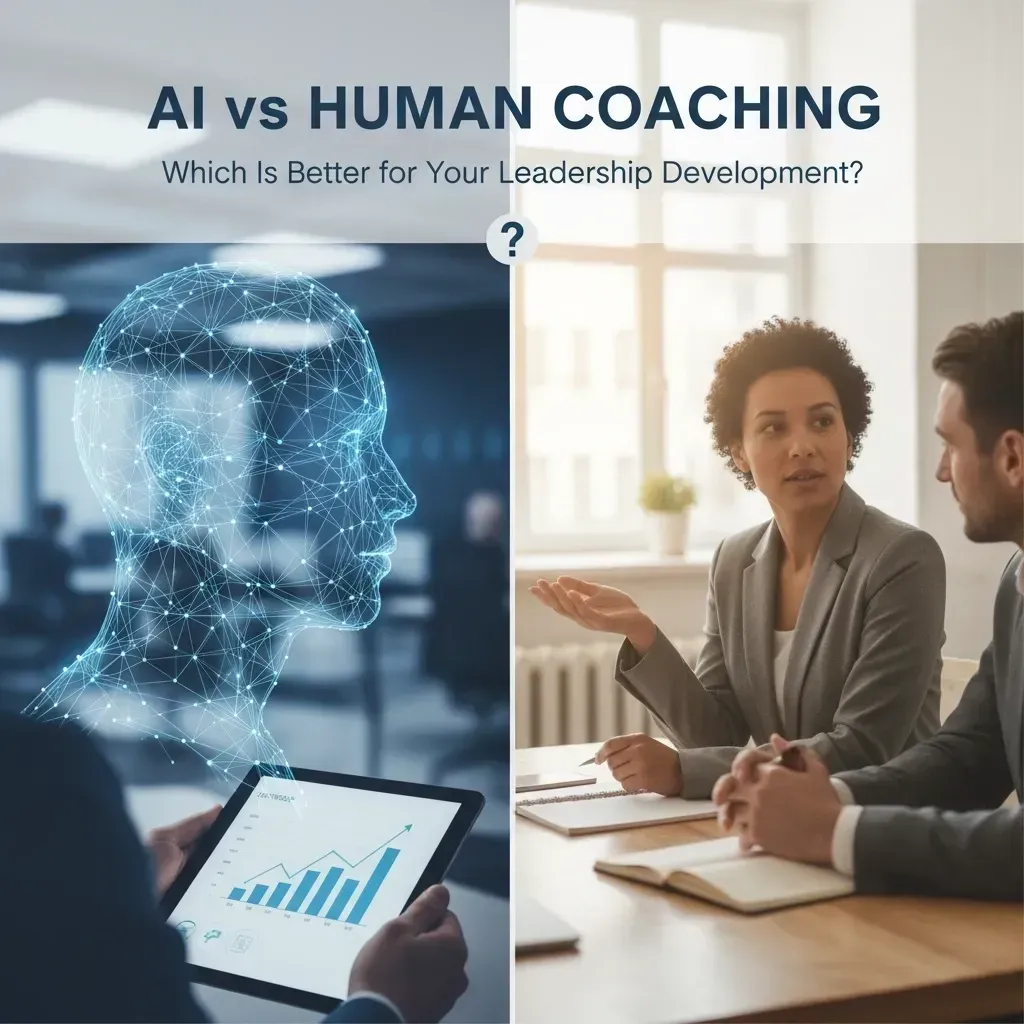
AI vs Human Coaching: Why Human Coaching Wins for Your Leadership
Right, let's get straight to the point. You're probably here because you've been bombarded with AI coaching apps promising to transform your leadership skills overnight, whilst simultaneously wondering if you should stick with good old-fashioned human coaching. I get it: it's a proper minefield out there.
The truth? This isn't a binary choice, but when it comes to meaningful leadership change, human coaching leads every time. AI can play a supporting role, but the richest shifts happen in real conversation with a real person.
"If you'd asked me a year ago if I'd condone AI coaching, I would have said absolutely not. But I suppose I've come to terms with the idea that it can have its benefits'the right place, right time scenario. However, we must be so careful not to replace these quality human interactions."
So let's look at where AI can help, and why the most meaningful work still belongs to humans.
The Rise of the Machines (In Coaching)
AI coaching has burst onto the scene like that colleague who suddenly discovers productivity apps and won't shut up about them. But here's the thing: some of the hype is actually justified.
The data doesn't lie: AI coaching tools can track your progress in ways that would make your most detail-obsessed manager weep with joy. They're measuring everything: how often you practice new skills, your completion rates, even analysing the sentiment of your communications. One company I came across improved their leadership communication by 25% through real-time feedback on speech patterns. Not bad for a bunch of algorithms.

And let's talk accessibility. Your AI coach doesn't sleep, doesn't take holidays, and definitely doesn't judge you for needing a pep talk at 11 PM on a Tuesday. It's there when inspiration strikes or when you need to work through something immediately. For busy leaders juggling impossible schedules, this availability is genuinely game-changing.
But here's where it gets interesting: and slightly terrifying. AI can access vast repositories of knowledge instantly. It's like having a coach who's read every leadership book, case study, and research paper ever written. Impressive? Absolutely. Useful for input and ideas? Yes. But a substitute for human coaching? Not even close.
The AI Coaching Reality Check
Now, before you cancel all your human interactions and pledge allegiance to our silicon overlords, let's have a word about AI's limitations. AI can "hallucinate": that's the technical term for when it confidently spouts complete nonsense. Imagine getting career advice from someone who occasionally forgets basic facts about how the world works. Not ideal when you're making decisions that affect real people and real businesses.
There's also the bias problem. AI learns from historical data, which means it can perpetuate the same prejudices and blind spots that have held back diverse leadership for decades. Without constant human oversight, your AI coach might inadvertently steer you towards outdated or discriminatory practices.
Most importantly, AI provides statistically probable answers based on patterns in data. But leadership isn't just about following patterns: it's about reading the room, understanding context, and sometimes doing something completely unexpected because your gut tells you it's right. That's why, when the stakes are human, human coaching must lead.
The Human Touch: Still Irreplaceable
Let me share something with you: the best leadership conversations I've ever had weren't the ones where I got the most information. They were the ones where someone asked me exactly the right question at exactly the right moment: something that shifted my entire perspective.
That's what skilled human coaches do. We don't just provide answers; we create the conditions for you to discover insights you didn't know you had.

Human coaches bring something AI simply cannot replicate: lived experience. When I'm working with a leader who's struggling with team dynamics, I'm drawing on decades of real-world successes and failures: my own and those of the hundreds of leaders I've coached. I've seen what actually works when the pressure's on and the stakes are high.
We're also brilliant at reading between the lines. That slight hesitation when you talk about a particular colleague? The way your energy shifts when discussing certain projects? These subtle cues tell us where the real work needs to happen: and they're completely invisible to AI.
The adaptability factor is crucial too. Every leadership journey is unique. What works for one person might be completely wrong for another, even if their situations look similar on paper. Human coaches adjust in real-time, shifting approaches based on what's actually happening in the moment. IQ solves problems. EQ solves people. That's human territory. And it only works inside a confidential space.
At One Feather Coaching, your coaching conversations are strictly confidential and remain private between coach and client — no recordings, no transcripts, no AI involvement.
Where Each Approach Shines
Let's get practical about when to use what. AI coaching seems good for:
Skill-building and practice (presentation skills, communication techniques)
Regular feedback and habit formation
Onboarding and standardised learning
Data tracking and progress measurement
When you need immediate, consistent support
Human coaching excels at:
Complex leadership transitions and strategic decisions
Navigating organisational politics and team dynamics
Developing emotional intelligence and self-awareness
Career pivots and major professional changes
When you need someone to challenge your thinking
Think of it this way: AI coaching is like having a brilliant personal trainer who can guide your daily workouts and track your progress. Human coaching is like having a seasoned mentor who helps you navigate career crossroads and develop the wisdom to lead others effectively. In short: use AI to practice; use humans to change.
The Hybrid Approach: Human-First, AI-Assisted
Here's what I'm seeing work brilliantly in practice: organisations using AI for the heavy lifting of data analysis and routine feedback, whilst reserving human coaches for the deep, transformational work.
And a crucial note on boundaries: at One Feather Coaching, coaching conversations are strictly confidential and remain private between coach and client — always. We don't record or transcribe content into any AI tools. That privacy is a core part of why human coaching works: it creates the safety for honest reflection and real change.
For large organisations, this approach makes perfect sense economically too. You can provide AI-powered support to hundreds or thousands of employees whilst having human coaches available for targeted interventions where they're most needed. But the non-negotiable constant is time with a skilled human coach.
Making Your Choice: A Framework
So, what's right for you right now? Ask yourself these questions:
What stage are you at in your leadership journey?
Early-career leaders often benefit from AI's structured skill-building approach. Senior leaders dealing with complex strategic challenges typically need the nuanced guidance only humans provide.
What specific challenges are you facing?
Technical skills and process improvements? AI might be perfect. Navigating difficult relationships or organisational change? You'll want human insight.
How do you prefer to learn?
Some people thrive with constant, data-driven feedback. Others need space to reflect and explore ideas in conversation.
What's your budget and timeline?
AI coaching is more accessible financially and available immediately. Quality human coaching requires investment and often has waiting lists.
The Future of Leadership Development
Here's my take: the future isn't about choosing between AI and human coaching. It's about creating integrated development experiences that leverage the best of both worlds. The leaders who'll thrive in the next decade won't be those who resist AI or those who rely on it exclusively. They'll be the ones who understand when to leverage technology and when to invest in human wisdom'and that wisdom is human.
Final Thought
Leadership development is human work. AI can nudge habits and surface data, but lasting change happens in trusted conversation, honest challenge, and the kind of nuanced reflection only a person can hold with you. If you're torn, choose the richer path first: work directly with a human executive coach, and let AI play a light supporting role when useful. Want to explore the difference for yourself? Consider the deeper impact of a human-led approach AI vs Human Coaching

